
Over the last decade, insurers have modernised parts of the underwriting process.
- Intake systems improved.
- Rating engines became more configurable.
- Workflow tools reduced manual handling.
Most of these changes were incremental. They optimised individual components rather than redesigning the system as a whole.
What is changing now is structural.
Underwriting orchestration is emerging as the strategic control layer across the Specialty Insurance lifecycle. It connects intake, triage, rating, portfolio oversight and governance into a coordinated operating framework.
Recent industry research assessing leading underwriting orchestration platforms reflects this shift. Orchestration is no longer viewed as workflow plumbing. It is increasingly recognised as foundational infrastructure.
That shift is significant.
Once orchestration becomes strategic, the next question is unavoidable.
Where does intelligence sit?
Coordination Is Not the Same as Decisioning
Orchestration platforms are designed to coordinate movement across systems.
- They route submissions.
- Trigger workflows.
- Integrate with core platforms.
- Expose portfolio data.
That coordination is necessary. It reduces friction and improves visibility.
But coordination alone does not improve underwriting judgement.
Specialty underwriting is defined by ambiguity. By incomplete information. By signal hidden inside unstructured data. Competitive advantage does not come from moving files more efficiently. It comes from interpreting risk more effectively.
That is where architecture matters.
The Difference Is Architectural There is an important distinction between:
- Automating tasks
- Orchestrating systems
- Embedding intelligence into the control layer itself
In many environments, artificial intelligence is added on top of existing workflows. A document extractor here. A pricing model there. A dashboard summarising output.
That approach can improve efficiency, but it does not change the underlying architecture.
In an AI-native underwriting platform, intelligence is not an overlay. It is designed into the system from the outset.
- Unstructured submissions are structured automatically.
- Risk signals are extracted and evaluated in context.
- Multiple AI agents can analyse different dimensions of risk simultaneously.
- Outputs are explainable and governed within the workflow, not outside it.
Intelligence operates within the orchestration layer, not adjacent to it.
That distinction determines whether AI meaningfully augments underwriting or simply accelerates existing constraints.
Why This Matters in Specialty Lines
Specialty insurance does not operate on uniform risk profiles or predictable flows.
Underwriters balance speed with disciplined appetite control. They operate under regulatory scrutiny. They manage accumulation risk across portfolios that can shift rapidly.
- An orchestration layer provides structure.
- An embedded intelligence layer provides insight.
When both are designed together, the result is not just faster processing. It is more consistent decisioning, better signal prioritisation and clearer governance.
This is not about replacing underwriting judgement. It is about strengthening it with structured intelligence at the point of decision.
The Next Phase of the Stack
The industry conversation is evolving.
- From digitisation of paper.
- To workflow automation.
- To orchestration across systems.
The next phase is embedding intelligence directly into that orchestration layer.
Orchestration is becoming foundational infrastructure.
What differentiates platforms now is how deliberately intelligence is designed within that foundation.
That is the architectural shift underway.
The market is recognising underwriting orchestration as strategic. The next step is ensuring the intelligence inside that layer is equally intentional.
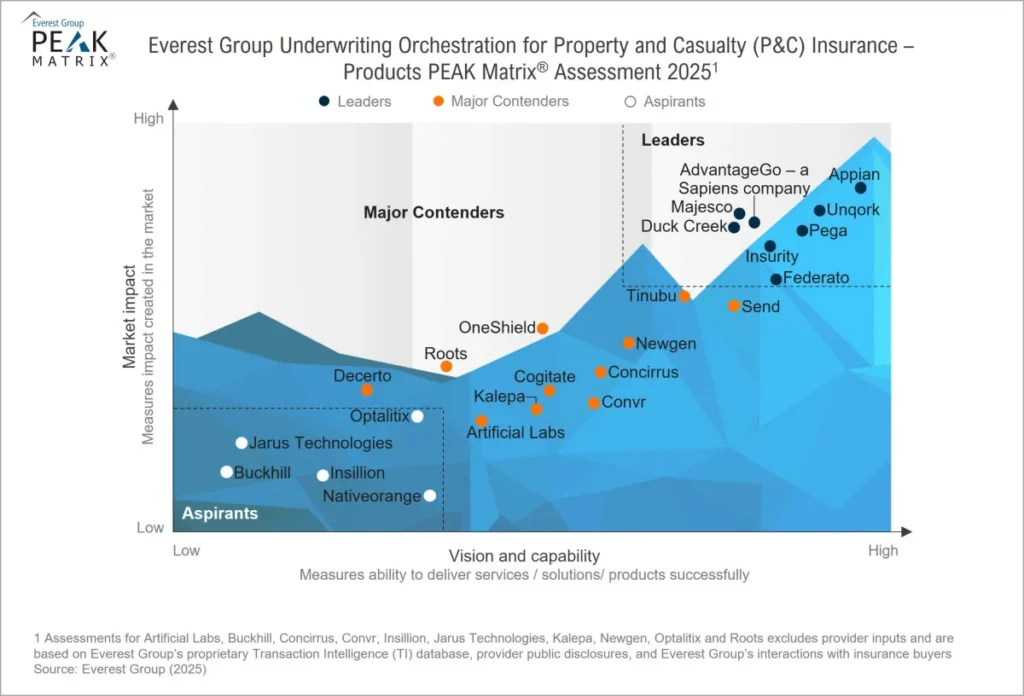
Everest Group Underwriting Orchestration for Property and Casualty Insurance – Products PEAK Matrix® Assessment 2025.
